

 CryptoTicker
5.5 percent more difficulty from Friday: Bitcoin miners face the year's third-largest step up
On Friday, October 16, the Bitcoin network will make itself more expensive. At around 14:00 UTC the blockchain reaches height 971,712, and the next mining difficulty adjustment takes effect. On Tuesday afternoon's reading, it comes out at 5.49 percent to the upside. That is the third-largest increase of this year, and it hits an industry whose product trades 33.8 percent below its record of $126,080.
This is not a technical footnote for investors. Difficulty determines how much computation a new Bitcoin costs, and with it the floor below which a miner would rather sell its coins than hold them. This article works through how much more expensive production becomes on Friday, which levels the price has behind it, and what you can check before the date.
132.72 trillion: what mining difficulty is showing right nowMining difficulty is a number the Bitcoin network resets every 2,016 blocks. It governs how hard it is to find a valid block, and so keeps the average block time at ten minutes. When computing power on the network rises, difficulty follows it up. When computing power falls, difficulty falls.
It currently stands at 132.72 trillion. The last adjustment on October 3 was effectively a non-event at minus 0.03 percent. Since then, miners have brought too much power to the network: blocks are arriving every 9.49 minutes on average instead of every ten, roughly half a minute too fast. That half minute is exactly what the protocol takes back on Friday.
On Tuesday afternoon, 438 of the current period's 2,016 blocks were still outstanding, with 78.3 percent of the window elapsed. The further a period has run, the more stable the estimate becomes. At 78 percent, experience suggests the expected figure moves only by a few tenths of a percentage point, as long as no large mining fleet is switched off.
Friday at around 14:00 UTC: how the 5.5 percent figure comes aboutOn reaching the target height, the protocol compares how long the past 2,016 blocks actually took with the 20,160 minutes they should have taken. The ratio between the two gives the new difficulty. If blocks ran 5.2 percent fast, difficulty rises by roughly 5.5 percent.
The date itself does not depend on the clock but on the block counter. The estimated time of 13:59 UTC is a projection from the current block speed. If the remaining blocks arrive faster, the date moves half an hour forward; if they arrive more slowly, it slips back. That is not a timetable, but it is a reliable order of magnitude.
 The moment of the adjustment is not in the calendar; it follows from the speed of the next 438 blocks.$82,500 did not hold: where things stand since Monday
Our Bitcoin forecast from Monday centred on the $82,500 level, together with the inflation print on October 14 and the rate decision on October 28. That level did not hold at the low. Over the past 24 hours the price fell as far as $81,018, almost $1,500 below it, and then came back.
On Tuesday afternoon, Bitcoin trades at $83,412. Against Monday's close of $81,795 that is 2.0 percent higher. Over one week the price is still down 2.7 percent, over 30 days up 8.2 percent. The move back below $82,500 was therefore not a break in the uptrend, but it shows that this line is softer than it looked on Monday.
What has been added since is Friday's date. On Monday it was not yet firmly in view, because the current period was only half elapsed and the estimate was swinging accordingly.
1.00 zettahash per second: the computing power behind the adjustmentBehind the increase sits a figure the network reached only recently: computing power stands at 1.00 zettahash per second. One zettahash is 1,000 exahash, a one followed by 21 zeros in computing operations every second. Averaged over the past three days, the figure ranged between 0.999 and 1.029 zettahash.
That power is the actual reason for the adjustment. Miners have switched on machines over the past two weeks even though the price has given ground since the start of October. This is the classic pattern after a hardware delivery: new machines go online because they were ordered and paid for, not because the price argues for it right now.
Why revenue per terahash falls by 5.2 percentHere is the mechanism that links the technology to your portfolio. The network pays out a fixed amount per block, currently 3.125 Bitcoin plus fees. The difficulty adjustment does not change that amount. What changes is the number of competitors for the same pot.
If difficulty rises by 5.49 percent, a miner with unchanged hardware receives only the reciprocal of that, 94.80 percent of its previous share. Its revenue per terahash of computing power falls by 5.20 percent. Its electricity bill stays the same. A miner sitting just above its costs before Friday sits below them afterwards.
That is where the selling pressure discussed around such dates comes from. A miner that can no longer cover its bill out of current revenue has to sell coins from its holdings or switch off machines. If it switches off, computing power falls, and the adjustment after next comes out to the downside again. This feedback loop has run since 2009, and it is the reason the network keeps going even after heavy price losses.
450 Bitcoin a day against $32 billion of turnoverThe scale belongs in the picture, however, or real cost pressure turns into an overblown price story. The network produces roughly 450 Bitcoin a day from the block subsidy, about $37.5 million at $83,412. Trading turnover in Bitcoin over the same 24 hours came to $32.4 billion.
Even if miners sold their entire daily output immediately, that would be around 0.12 percent of daily turnover. The cost pressure from the adjustment is existential for the companies affected; for a single day's price it is a small quantity. Fund flows weigh far more heavily at the moment: according to Farside Investors data cited by CoinDesk, Bitcoin funds saw net outflows of $65.4 million on October 12, and roughly $681 million in the week to October 9.
Reading the adjustment as the sole explanation for the price therefore overstates it. Ignoring it means missing a cost threshold that shows up in the quarterly numbers of the listed miners.
The third-largest increase of the year: every 2026 adjustment comparedWhether 5.5 percent is a lot only becomes clear in hindsight. We read out every adjustment of this year from the block data at mempool.space and set them against each other.
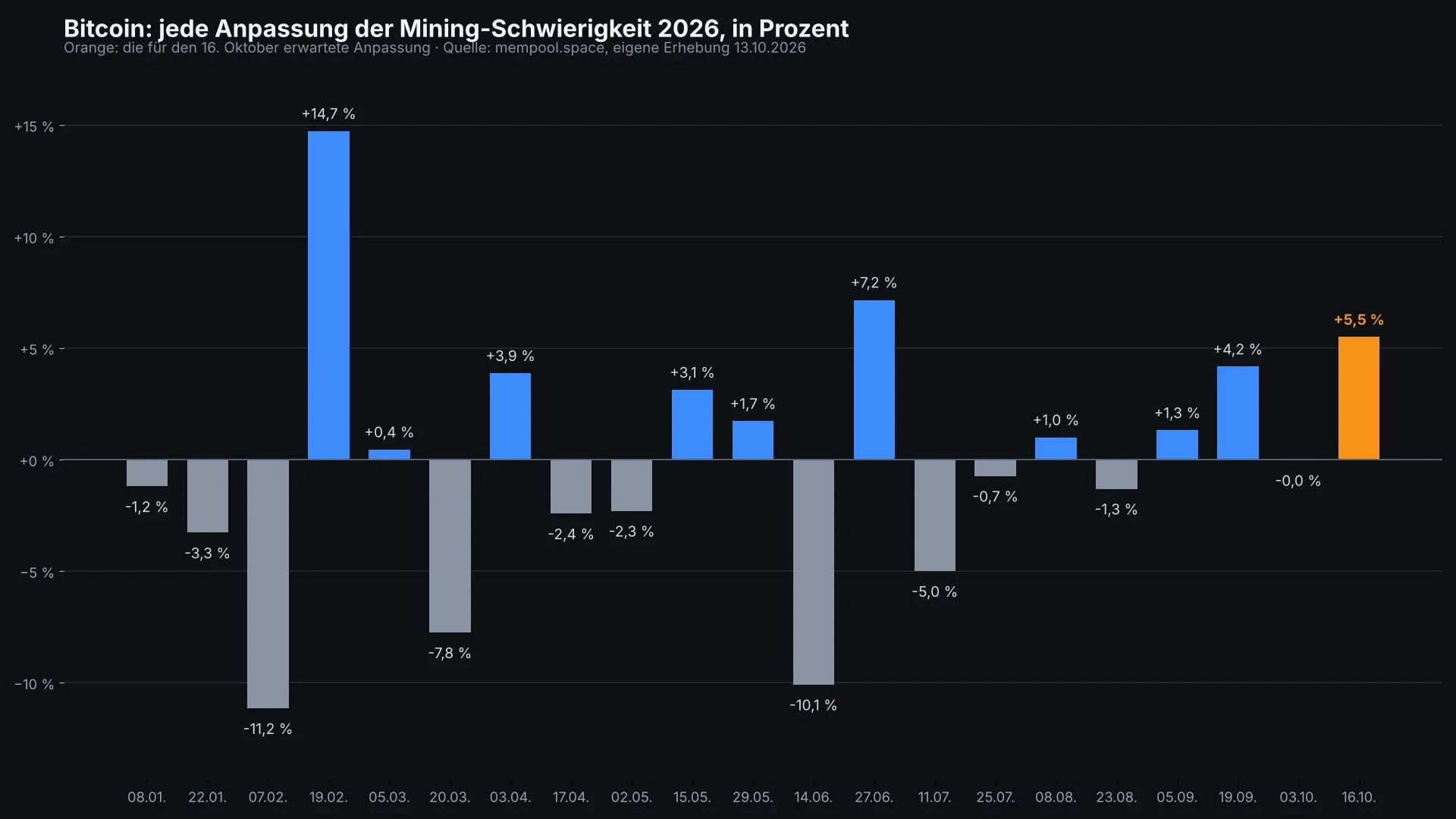 Twenty adjustments since January, plus the expectation for October 16 in orange.
Only two increases were larger in 2026: 14.7 percent on February 19 and 7.2 percent on June 27. Friday follows with 5.5 percent, ahead of the 4.2 percent on September 19. The downside swings were sharper: minus 11.2 percent on February 7 and minus 10.1 percent on June 14.
Across the past 26 adjustments, a good year, difficulty rose 11 times and fell 15 times. On balance, the network lost power rather than gained it in 2026. Friday runs against that trend, and that is what makes it notable: computing power is growing into a weak price.
$81,018 and $84,074: the levels for the coming daysFor the price, that yields clear checkpoints. On the downside sits the daily low of $81,018. Below it comes the 50-day line at $81,110, which the price currently sits 2.8 percent above. The two levels are so close together that they form a zone rather than two separate lines. If the price breaks through there, the next demonstrable stop is the monthly low of $75,590.
On the upside stands the daily high of $84,074, and above it the monthly high of $86,597. The 200-day line sits far below at $72,123: the price has 15.7 percent of headroom above it. As long as that gap holds, the long-term uptrend is intact, even with the short-term lines under pressure.
Friday's adjustment does not create any of these levels. The date concerns costs, not the price. Deriving levels from it means measuring the wrong thing.
Savings plans and fees: what a €100 instalment really costsFor investors in Germany, the practical question on a date like this is rarely whether to buy, but at what cost. There is a lever here that you control, unlike the price itself.
An example: on a monthly instalment of €100, an instant purchase through an exchange's trading window costs between 0.99 and 1.49 percent depending on the provider, so 99 cents to €1.49. The same instalment placed in the order book of the same exchange often costs 0.1 to 0.4 percent, so 10 to 40 cents. Over twelve months that is a difference of around €13 on €1,200 committed. That is more than most price moves of a single week come to on that amount.
You can check this in three places: your provider's fee schedule, the statement from your last savings-plan execution, and the spread, the gap between the buy and sell price at the moment of execution. Which providers run which models is in our comparison of Bitcoin savings plans; if you place the instalment in the order book yourself instead, the fee tiers are in our overview of crypto exchanges.
A second point concerns the execution day. Many providers let you choose it freely. A fixed day is preferable to trying to dodge dates such as Friday: the cost advantage of a well-chosen day cannot be demonstrated, whereas the disadvantage of a skipped instalment can.
How to check the next adjustment yourselfYou do not need a paid data source for this. The block data is public, and the route takes less than a minute.
Open the mining overview at mempool.space. Four figures there add up to the picture: current difficulty, the expected change in percent, the number of remaining blocks and the estimated time to the date. If remaining blocks are below 500, the estimate is reliable. If they are above 1,500, the period is still near its start, and the percentage can halve or double.
The fifth figure you work out yourself: divide 1 by the factor of the change. At plus 5.49 percent, 1 divided by 1.0549 gives 0.948. Revenue per unit of computing power falls by those 5.2 percent. The same calculation works for a decrease and then gives a plus.
From the editorial team's view: the adjustment raises production costs, it does not turn the priceOur read on Friday is sober. Three pieces of evidence support it: daily production of 450 Bitcoin equals 0.12 percent of the $32.4 billion in daily turnover; the previous week's fund outflows, at $681 million, were many times larger; and across the past 26 adjustments the price has shown no discernible regularity around these dates.
One argument runs the other way, and we will not play it down: if the increase meets a stretch of persistently weak prices, the miners with the highest electricity costs come under pressure, and their sales land in an already thin market. That effect is real, but it shows up over weeks in the holdings of mining companies, not on a Friday afternoon in the candle chart.
In short: October 16 is a cost date for an industry, not a turning point for the price. Positioning a portfolio around it confuses the production side with the demand side. If you want to know how solid the network is, rising computing power is a strong argument in its favour.
Mining difficulty: October 16 makes every new Bitcoin more expensiveFriday's adjustment lifts production costs by a good five percent while the price sits a third below its record. Three steps follow from that:
- Keep an eye on the zone between $81,018 and $81,110. The daily low and the 50-day line sit almost on top of each other there. If that zone holds, Monday's picture stands. If you want to place a buy order there, the fee models are in our comparison of crypto exchanges.
- Recalculate your own purchase costs. Instant purchase and order book are around one euro apart on a €100 instalment, roughly €13 over a year. The models are in our overview of Bitcoin savings plans.
- Review leveraged positions before October 28. Two weeks with several scheduled events lie between Friday's adjustment and the rate decision. If you work with leverage, the terms are in our comparison of crypto brokers.
(As of October 13, 2026. This article is not investment advice. Prices and fee structures change; check the terms with the provider before you buy.)


